

Introduction
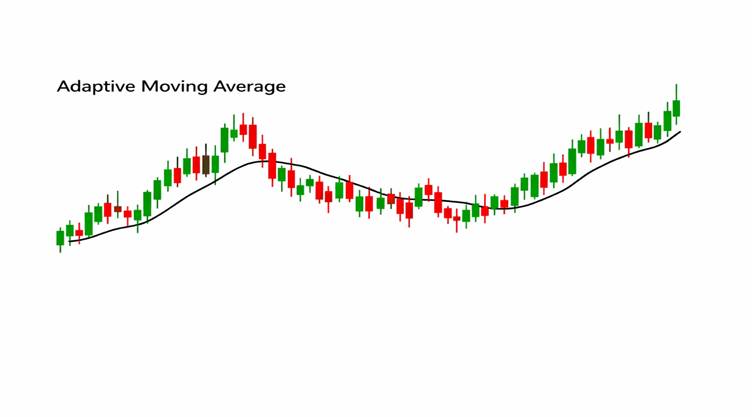
The Adaptive Moving Average (AMA or AMAT) was developed by Perry Kaufman to address the limitations of traditional moving averages. While simple and exponential moving averages often lag, AMA adapts to market volatility, becoming more responsive during strong trends and smoother during sideways conditions.
Structure
- Formula: AMA uses an efficiency ratio (ER) to measure trend strength.
- ER = (Change in price ÷ Sum of absolute price changes).
- AMA = Previous AMA + (Smoothing Constant × (Price – Previous AMA)).
- The smoothing constant adjusts based on ER, making AMA adaptive.
Features
- Lag Reduction: Reacts quickly in trending markets.
- Noise Filtering: Smooths out sideways movements.
- Dynamic Sensitivity: Adjusts automatically to volatility.
- Versatility: Works across all timeframes and asset classes.
How It Helps Traders
AMA helps traders avoid whipsaws in sideways markets while capturing strong trends early. For example, during a breakout, AMA shifts quickly to align with price, signaling entry opportunities. In range-bound conditions, it flattens, warning traders to avoid trend-based strategies. This adaptability makes AMA ideal for both swing and long-term investors.
Conclusion
The Adaptive Moving Average is a sophisticated evolution of traditional moving averages. By adjusting sensitivity based on market conditions, it provides traders with a more reliable trend-following tool. For those seeking balance between responsiveness and smoothness, AMA is a valuable addition to any trading system.
