

Introduction
The Kaufman’s Adaptive Moving Average (KAMA), developed by Perry J. Kaufman in 1998, is a sophisticated moving average designed to adapt dynamically to market volatility. Unlike traditional moving averages that apply fixed smoothing, KAMA adjusts its sensitivity based on market noise and trend strength. This makes it highly effective in filtering out false signals during choppy markets while remaining responsive during strong trends.
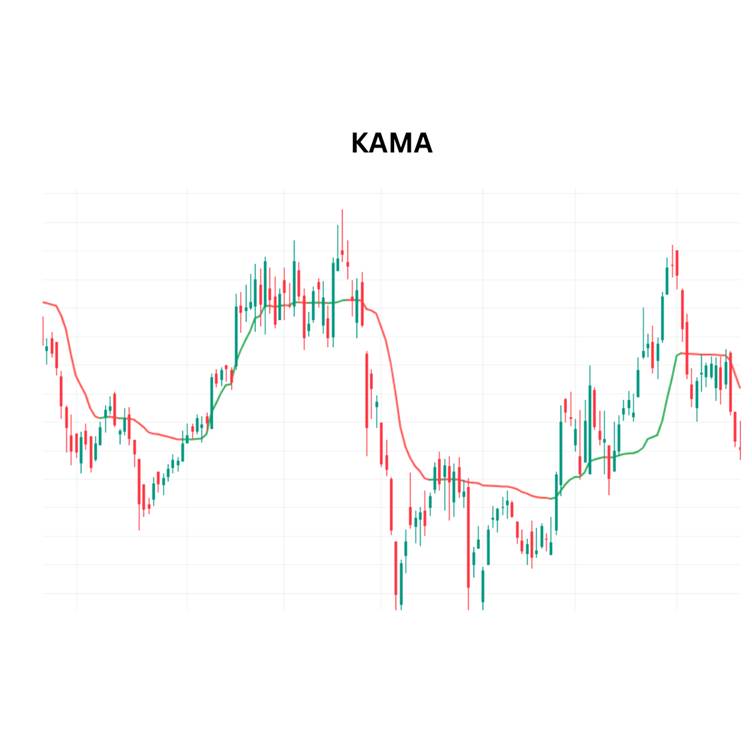
Structure of the KAMA Indicator
The KAMA calculation involves three key steps:
- Efficiency Ratio (ER): Measures the efficiency of price movement by comparing net price change to volatility.
[ ER = {Change}{Volatility} ]- High ER → Strong trend, low noise.
- Low ER → Weak trend, high noise.
- Smoothing Constant (SC): Adjusts based on ER, ranging between fast and slow moving average constants.
- KAMA Formula:
[ KAMA_t = KAMA_{t-1} + SC (Price_t – KAMA_{t-1}) ]
This adaptive structure ensures KAMA reacts quickly in trending markets and slows down in sideways conditions.
Key Features
- Adaptive Nature: Adjusts sensitivity based on volatility.
- Noise Reduction: Filters out false signals in choppy markets.
- Trend Clarity: Smooths price action while remaining responsive.
- Versatility: Works across multiple timeframes and asset classes.
- Integration Friendly: Can be paired with oscillators or volume indicators for confirmation.
How It Helps Traders
- Trend Identification: Price above KAMA suggests bullish sentiment; below KAMA suggests bearish sentiment.
- Entry & Exit Points: Crossovers between price and KAMA generate reliable buy/sell signals.
- Risk Management: Reduces false entries by filtering noise, improving trade discipline.
- Reversal Detection: Helps spot early trend changes due to its adaptive responsiveness.
- Strategy Integration: Works well with RSI, MACD, or breakout strategies for layered confirmation.
Conclusion
The KAMA Indicator is a next-generation moving average tool that balances responsiveness with stability. By adapting to volatility, it helps traders stay aligned with genuine market momentum while avoiding false signals in noisy conditions. Although it should not be used in isolation, combining KAMA with momentum or volume-based indicators enhances accuracy and confidence. For traders seeking a disciplined, adaptive approach to trend analysis, Kaufman’s Adaptive Moving Average offers a structured framework to navigate bullish and bearish markets effectively.
