

Introduction
The EMA + RSI Strategy is a hybrid trading approach that combines the Exponential Moving Average (EMA), a trend-following indicator, with the Relative Strength Index (RSI), a momentum oscillator. EMA smooths price data to highlight the prevailing trend, while RSI measures momentum and identifies overbought or oversold conditions. Together, they provide traders with a balanced framework for spotting trend continuations, reversals, and disciplined entry/exit points.
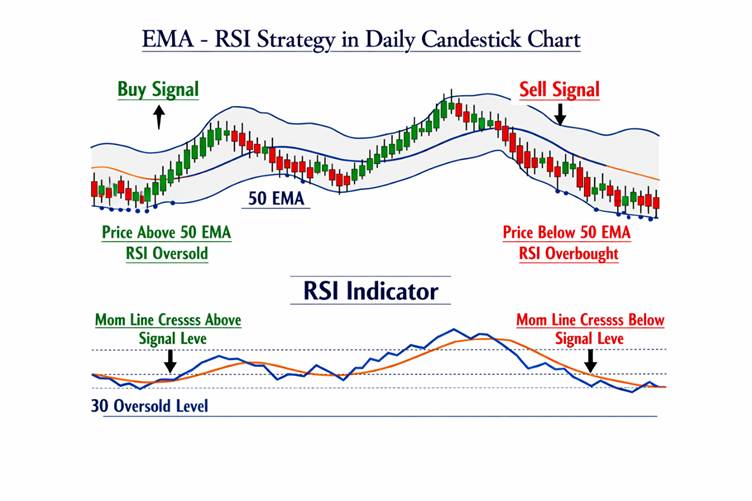
Structure of the Strategy
The strategy integrates two complementary tools:
- Exponential Moving Average (EMA):
- Short-term EMA (e.g., 9 or 20 periods) → captures immediate trend direction.
- Long-term EMA (e.g., 50 or 200 periods) → identifies broader market bias.
- Signals: Price above EMA = bullish trend; price below EMA = bearish trend.
- Relative Strength Index (RSI):
- RSI above 70 → overbought zone, potential downward reversal.
- RSI below 30 → oversold zone, potential upward reversal.
- RSI crossing 50 → trend confirmation (above = bullish, below = bearish).
- Combined Signal:
- Buy when price is above EMA and RSI rises above 50.
- Sell when price is below EMA and RSI falls below 50.
- Divergences between RSI and EMA trend can highlight early reversal opportunities.
Key Features
- Trend + Momentum Combination: EMA captures trend direction, RSI validates momentum strength.
- Dual Confirmation: Reduces false signals by requiring both indicators to align.
- Versatility: Works across multiple timeframes and asset classes.
- Clear Entry/Exit Points: Provides structured, rule-based signals.
- Adaptability: Can be customized with different EMA lengths and RSI thresholds.
How It Helps Traders
- Improves Accuracy: Dual-layer confirmation reduces false entries in volatile markets.
- Identifies Extremes: RSI highlights momentum exhaustion, while EMA confirms trend bias.
- Trend Participation: Keeps traders aligned with prevailing momentum.
- Reversal Detection: Divergences between RSI and EMA warn of potential market shifts.
- Risk Management: Provides clear zones for stop-loss placement and profit-taking.
Conclusion
The EMA + RSI Strategy is a powerful trading method that blends trend-following analysis with momentum confirmation. By combining EMA’s ability to highlight directional bias with RSI’s overbought/oversold signals, traders gain a structured framework for identifying high-probability setups. While false signals can occur in sideways markets, pairing this strategy with support/resistance levels or volume analysis enhances reliability. Its clarity, adaptability, and dual confirmation make it suitable for traders at all levels. For those seeking a disciplined, rule-based approach to trend and momentum trading, the EMA + RSI Strategy offers a clear pathway to confident decision-making and profitable opportunities.
