

Introduction
The Directional Movement Index (DMI), developed by J. Welles Wilder Jr. in 1978, is a trend-strength indicator that helps traders determine whether a market is trending and in which direction. It is widely used in combination with the Average Directional Index (ADX) to measure both the strength and direction of a trend. DMI is particularly valuable because it not only identifies whether a trend exists but also distinguishes between bullish and bearish momentum.
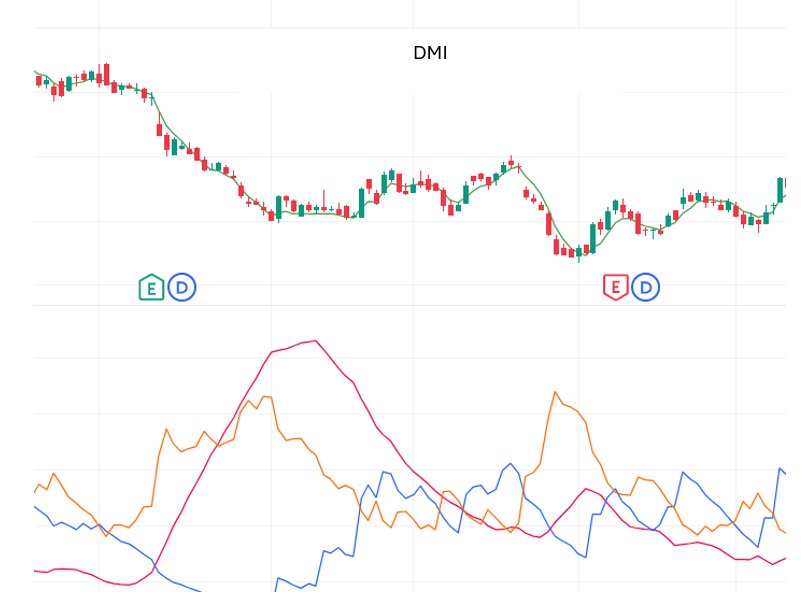
Structure of the DMI Indicator
The DMI consists of three main components:
- +DI (Positive Directional Indicator): Measures upward price movement.
- -DI (Negative Directional Indicator): Measures downward price movement.
- ADX (Average Directional Index): Measures the overall strength of the trend, regardless of direction.
Interpretation:
- When +DI > -DI, buyers dominate (bullish trend).
- When -DI > +DI, sellers dominate (bearish trend).
- A rising ADX confirms a strong trend, while a falling ADX suggests weakening momentum.
Key Features
- Trend Direction: Identifies whether bulls or bears are in control.
- Trend Strength: ADX component shows how strong the trend is.
- Versatility: Works across multiple timeframes and asset classes.
- Crossover Signals: +DI and -DI crossovers provide buy/sell triggers.
- Noise Filtering: Helps avoid trading in sideways, low-momentum markets.
How It Helps Traders
- Trend Identification: Confirms whether the market is trending or consolidating.
- Entry & Exit Points: Buy signals occur when +DI crosses above -DI, and sell signals occur when -DI crosses above +DI.
- Risk Management: Avoids trades in weak or sideways markets by checking ADX values.
- Strategy Selection: Guides traders to use trend-following strategies when ADX is strong and range-bound strategies when ADX is weak.
- Portfolio Allocation: Helps allocate capital to assets showing strong directional momentum.
Conclusion
The Directional Movement Index is a powerful trend analysis tool that combines direction (+DI and -DI) with strength (ADX) to give traders a complete picture of market behavior. Its ability to filter out sideways markets and highlight genuine trends makes it a cornerstone of technical analysis. While DMI should not be used in isolation, pairing it with oscillators or volume-based indicators enhances accuracy and confidence. For traders seeking disciplined, trend-focused strategies, the DMI Indicator offers a structured framework to navigate bullish and bearish phases effectively.
