

What Is the Bullish Harami Cross?
The Bullish Harami Cross is a variation of the Bullish Harami pattern. It consists of a large bearish candle followed by a Doji candle (open and close nearly equal) that is contained within the body of the first candle. The Doji reflects indecision, weakening the prior bearish momentum.
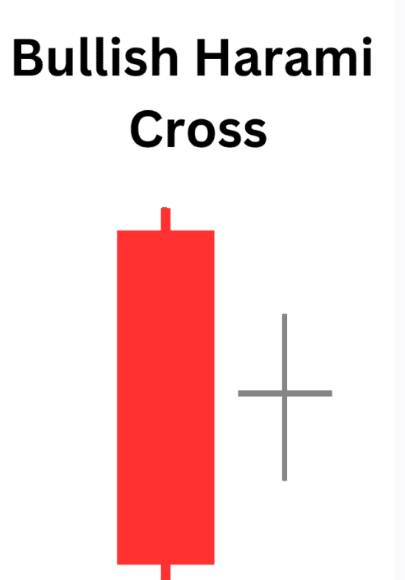
Candle Formation Breakdown
- First Candle: A long bearish (red/black) candle continuing the downtrend.
- Second Candle: A Doji candle that opens and closes within the body of the first candle.
Key Traits to Recognize
- Appears after a prolonged decline.
- The Doji signals indecision and loss of bearish strength.
- Stronger when confirmed by subsequent bullish candles.
- Often appears near support zones.
Market Psychology Behind the Pattern
- Sellers dominate initially, pushing prices lower (first candle).
- The Doji shows hesitation, as neither buyers nor sellers gain control.
- Traders interpret this as a warning of potential reversal.
- Buyers often step in after confirmation, driving prices higher.
Limitations to Keep in Mind
- The Bullish Harami Cross alone does not guarantee reversal.
- False signals are possible without confirmation.
- Should be combined with other indicators (RSI, MACD, moving averages, or volume analysis).
Final Thoughts
The Bullish Harami Cross candlestick pattern is a subtle but powerful reversal signal. Recognizing it at the bottom of a downtrend can help traders anticipate recoveries and adjust their strategies with confidence.
