

Bollinger Bands (BBands) are one of the most widely used technical indicators in trading, developed by John Bollinger. They measure volatility and provide dynamic support and resistance levels around price action. Traders rely on Bollinger Bands to identify overbought/oversold conditions, breakout opportunities, and trend continuation signals.
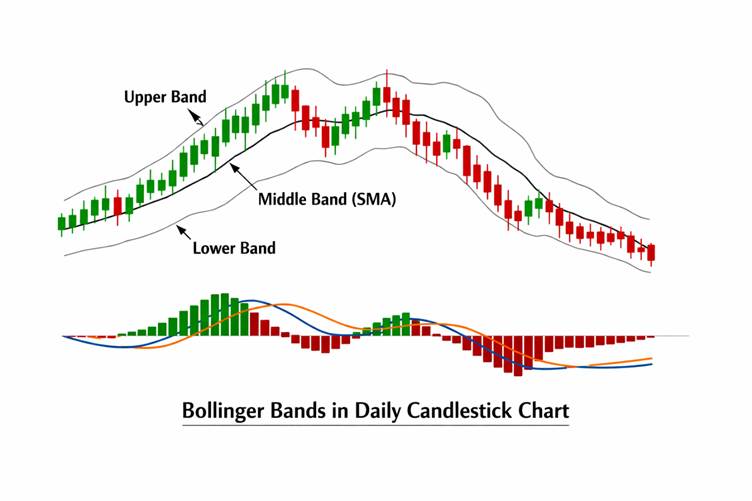
Structure of Bollinger Bands
Bollinger Bands consist of three lines plotted on a price chart:
- Middle Band: A simple moving average (usually 20-period SMA).
- Upper Band: Middle Band + (2 × standard deviation).
- Lower Band: Middle Band – (2 × standard deviation).
The distance between the upper and lower bands expands or contracts based on market volatility.
Features
- Volatility-based: Bands widen during high volatility and contract during low volatility.
- Dynamic support/resistance: Price often reacts to the upper and lower bands like barriers.
- Mean reversion tool: Price tends to return to the middle band after touching extremes.
- Breakout signals: Band squeezes (narrowing) often precede strong price moves.
- Adaptability: Works across multiple timeframes and asset classes.
How Bollinger Bands Help Traders
- Identify extremes: When price touches the upper band, it may signal overbought conditions; touching the lower band may indicate oversold conditions.
- Spot breakout opportunities: A squeeze (narrow bands) suggests consolidation, often followed by a sharp breakout.
- Trend confirmation: Sustained movement along the upper band signals strong bullish momentum, while movement along the lower band signals bearish strength.
- Risk management: Helps traders set stop-loss and take-profit levels by using bands as dynamic boundaries.
- Versatility: Can be combined with other indicators like RSI, MACD, or candlestick patterns for higher accuracy.
Conclusion
Bollinger Bands are a versatile and powerful tool that blend volatility measurement with trend analysis. Their ability to highlight overbought/oversold zones, breakout potential, and trend strength makes them indispensable for traders across markets. While they should not be used in isolation, combining Bollinger Bands with complementary indicators enhances decision-making and reduces false signals. For traders seeking clarity in volatile markets, BBands provide a structured framework to anticipate price movements and manage risk effectively.
