

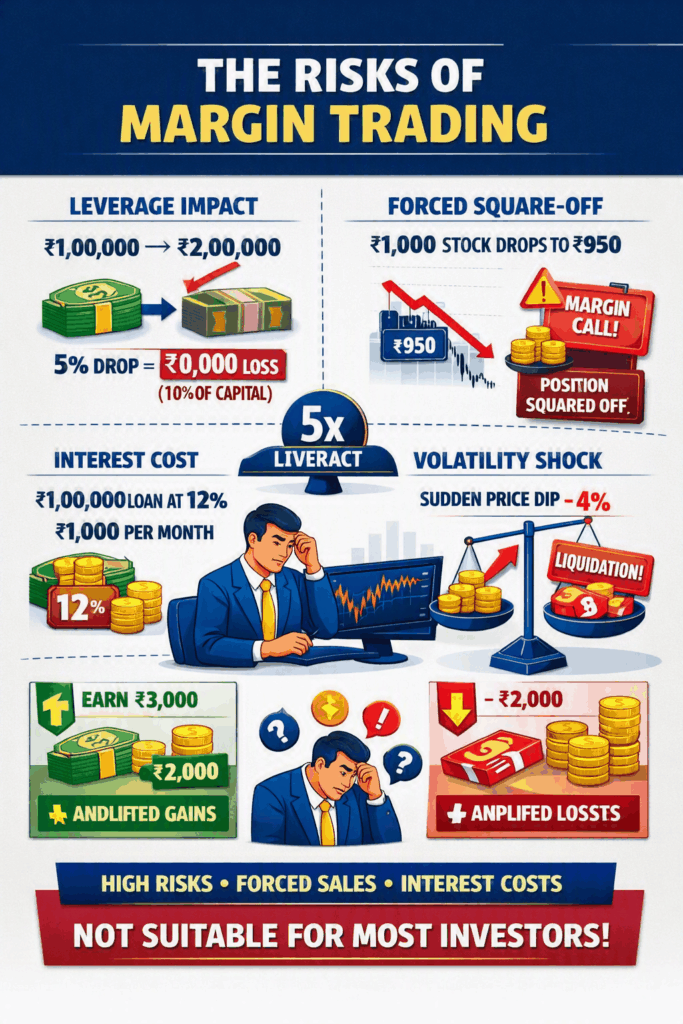
Margin trading means you borrow money from your broker to take a larger position than your actual capital allows. While this leverage can amplify gains, it magnifies losses even faster — and for most investors, the risks quietly outweigh the benefits.
How Margin Risk Actually Plays Out
1. Leverage Impact
Suppose you have ₹1,00,000 and take a margin position worth ₹2,00,000. If the stock falls just 5%, your position drops by ₹10,000. That’s a 10% loss on your actual capital — because the borrowed money still needs to be repaid in full, regardless of how the trade performs.
2. Forced Square-Off
Imagine you buy a stock at ₹1,000 using margin. It dips to ₹950 due to normal volatility. Even if the company is fundamentally strong, your broker may trigger a margin call and square off your position automatically. You lose money without ever getting the chance to hold or recover.
3. Interest Cost Drag
If you borrow ₹1,00,000 at 12% annual interest, that’s roughly ₹1,000 per month. Even if your trade earns ₹3,000, your net gain shrinks to ₹2,000. And if the trade goes wrong, that interest simply adds to your losses.
4. Volatility Shock
A stock can fall 3–4% intraday due to news, global cues, or market sentiment. With margin, that small dip can wipe out a large chunk of your capital and trigger liquidation. Without margin, it’s just a normal fluctuation you could simply ride out.
The Domino Effect
Margin risk rarely stays contained to one trade. If you’re holding several leveraged positions and one drops sharply, your broker may square off other, unrelated holdings in your account to restore the required margin even profitable ones. A shock in a single stock can end up dragging down your entire portfolio.
Who Margin Might Actually Suit
Leverage isn’t universally reckless. Short-term traders working with strict stop-losses, investors hedging an existing position, or professionals with real-time risk monitoring sometimes use margin deliberately and briefly. The danger is retail investors using it to “size up” a long-term investment thesis — pairing a short-fuse tool with a long holding period.
Safer Alternatives to Leverage
If the goal is bigger returns, margin isn’t the only lever available — and it isn’t the safest one.
- Systematic Investment Plans (SIPs): Build a larger position over time using your own capital, spreading out entry price risk instead of amplifying it.
- Diversification: Spreading capital across sectors or asset classes reduces single-stock shock without borrowing a rupee.
- Reinvesting gains: Compounding your own profits back into the market grows position size without adding debt or interest cost.
- Options with defined risk: Certain options strategies offer leveraged exposure with a capped, known maximum loss — unlike margin, where losses (and margin calls) are open-ended.
Why This Makes Margin Trading Unsuitable for Most Investors: Margin converts a normal investment into a high-risk leveraged bet. You lose control due to broker-driven square-offs, pay interest regardless of outcome, and face amplified losses from small price moves. Emotionally, it creates stress, panic, and impulsive decisions exactly the opposite of long-term wealth building.
