

Introduction
In technical analysis, traders often combine multiple indicators to strengthen their decision-making. Two popular tools are On-Balance Volume (OBV) and the Moving Average Convergence Divergence (MACD). While OBV focuses on volume flow, MACD highlights momentum shifts. Together, they create a powerful strategy that blends price action with trading volume, offering deeper insights into market trends.
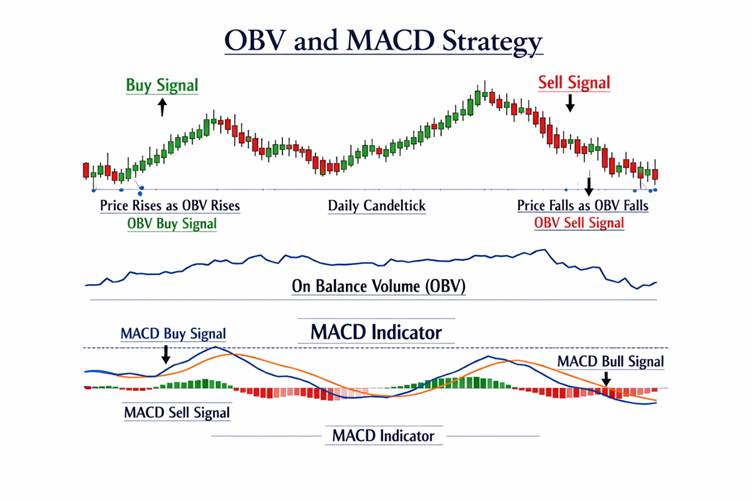
Structure of the Strategy
The OBV–MACD strategy is built on two pillars:
- OBV (On-Balance Volume): Tracks cumulative buying and selling pressure by adding volume on up days and subtracting it on down days.
- MACD (Moving Average Convergence Divergence): Uses the difference between two moving averages (usually 12-day and 26-day EMA) and a signal line (9-day EMA) to identify momentum changes.
The structure involves:
- Confirming trend direction with OBV.
- Spotting entry/exit signals with MACD crossovers.
- Using both indicators together to filter false signals.
Features of the Strategy
- Dual confirmation: Price trend validated by volume and momentum.
- Early trend detection: OBV often signals accumulation/distribution before price moves.
- Reduced false signals: MACD alone can mislead in sideways markets, but OBV adds clarity.
- Versatility: Works across stocks, forex, and commodities.
How It Helps Traders
- Identifies strong trends: When OBV rises alongside a bullish MACD crossover, traders gain confidence in upward momentum.
- Avoids traps: A bullish MACD signal without OBV support may indicate weak buying pressure, helping traders avoid false breakouts.
- Improves timing: OBV can hint at trend continuation, while MACD pinpoints entry and exit moments.
- Risk management: By combining indicators, traders reduce reliance on a single tool, lowering chances of poor decisions.
Conclusion
The OBV–MACD strategy is a synergistic approach that merges volume analysis with momentum tracking. OBV reveals the underlying strength of market moves, while MACD provides precise timing signals. Together, they empower traders to make more informed decisions, filter noise, and enhance profitability. While no strategy guarantees success, this combination offers a balanced framework for navigating volatile markets with greater confidence.
