

Introduction
The Pivot Reversal Strategy is a technical trading method that focuses on identifying potential turning points in the market using pivot levels. Pivots are calculated reference points derived from the previous period’s high, low, and close prices. When price action interacts with these levels, traders look for reversal signals that indicate a shift in market sentiment. This strategy is widely used in intraday and swing trading because it provides clear zones for support, resistance, and possible trend changes.
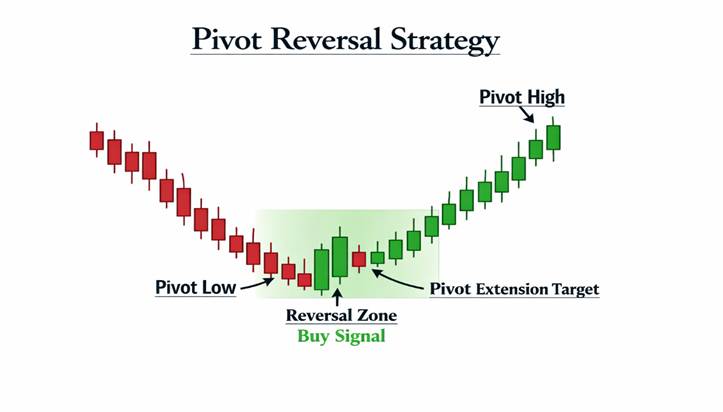
Structure of the Strategy
The Pivot Reversal Strategy is built around three main elements:
- Pivot Point: The central level calculated from the average of the previous period’s high, low, and close.
- Support Levels (S1, S2, S3): Derived below the pivot point, these act as potential reversal zones when price declines.
- Resistance Levels (R1, R2, R3): Derived above the pivot point, these serve as potential reversal zones when price rises.
- Reversal Signal: Traders watch for candlestick patterns, momentum shifts, or volume spikes near these pivot levels to confirm reversals.
Key Features
- Clear Reference Levels: Provides predefined support and resistance zones.
- Versatility: Works across multiple timeframes and asset classes.
- Combination-Friendly: Can be paired with candlestick patterns, RSI, or MACD for stronger signals.
- Risk Management: Offers natural stop-loss and profit-taking levels.
- Trend & Reversal Utility: Useful for both continuation trades and spotting turning points.
How It Helps Traders
- Identifies Key Market Levels: Pivot points highlight areas where price is likely to react.
- Reversal Detection: Helps traders anticipate turning points when price fails to break support or resistance.
- Entry & Exit Planning: Provides structured zones for entering trades and setting stop-losses.
- Intraday Advantage: Particularly effective for day traders who rely on short-term reversals.
- Confidence Building: Reduces emotional bias by offering rule-based decision-making.
Conclusion
The Pivot Reversal Strategy is a disciplined approach to trading that leverages pivot levels to anticipate market turning points. By combining these predefined support and resistance zones with price action and momentum indicators, traders gain a structured framework for identifying reversals and managing risk. While no strategy is foolproof, the Pivot Reversal Strategy’s clarity and adaptability make it a valuable tool for both beginners and experienced traders. For those seeking to strengthen their technical analysis and trade with confidence, this strategy provides a rule-based pathway to capturing reversal opportunities in dynamic markets.
