

Advance/Decline Line
Introduction
The Advance/Decline (A/D) Line is a breadth indicator that measures overall market sentiment by tracking the number of advancing stocks versus declining stocks. It is widely used to confirm the strength of market trends and detect divergences between price indices and underlying market participation.
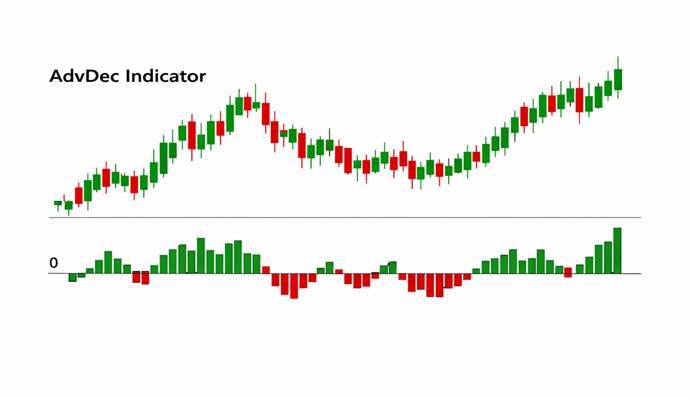
Structure
- Advancing Issues: Number of stocks closing higher than the previous day.
- Declining Issues: Number of stocks closing lower.
- Formula:
A/D Line = Previous A/D Value + (Advancing Issues – Declining Issues) - Plotted as a cumulative line alongside major indices like the S&P 500 or Nifty 50.
Features
- Market Breadth Gauge: Shows whether a rally is broad-based or narrow.
- Trend Confirmation: Rising A/D Line confirms bullish sentiment; falling line signals bearish sentiment.
- Divergence Detection: If the index rises but the A/D Line falls, it warns of weakening momentum.
- Versatility: Works across equities, indices, and ETFs.
How It Helps Traders
The A/D Line helps traders avoid being misled by index movements driven by a few large-cap stocks. For example, if the Nifty 50 rises but the A/D Line declines, it suggests fewer stocks are participating in the rally, raising caution. Traders use it to confirm breakouts, validate bullish or bearish phases, and anticipate reversals when divergences appear.
Conclusion
The Advance/Decline Line is a powerful tool for understanding market breadth. By highlighting whether rallies or declines are supported by broad participation, it helps traders confirm the sustainability of trends. When combined with price action and volume indicators, it provides a more complete picture of market health.
