

Introduction
The Ease of Movement (EOM) Indicator, developed by Richard W. Arms, is a volume-based oscillator that measures the relationship between price change and volume. It highlights how easily price moves up or down given the trading volume. When combined with a crossover strategy (using moving averages of EOM), traders can identify momentum shifts and potential entry or exit points. The EOM crossover is particularly useful for spotting trend reversals and confirming breakouts.
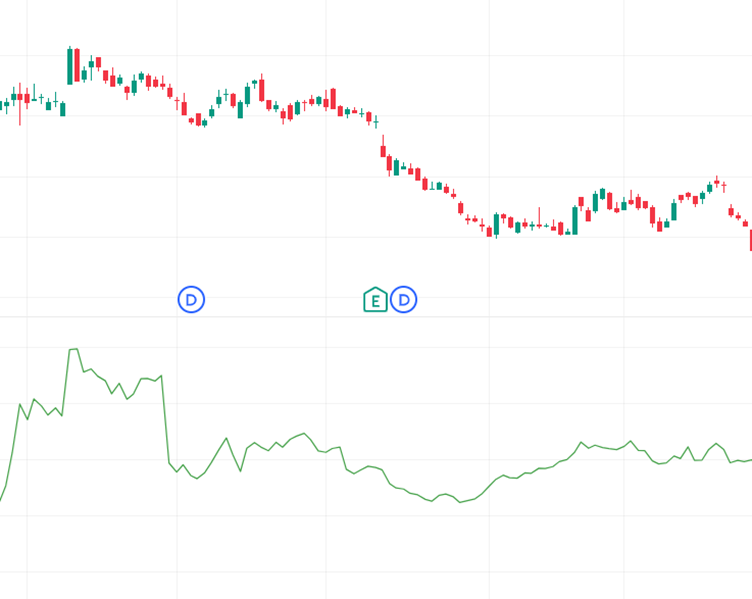
Structure of the EOM Crossover
The EOM is calculated using:
- Midpoint Move = ({High + Low}{2} – {Prior High + Prior Low}{2})
- Box Ratio = ({Volume}{High – Low})
- EOM Value = Midpoint Move ÷ Box Ratio
- The raw EOM values are smoothed using a moving average (commonly 14-period).
- In the crossover method, a short-term EOM moving average is plotted against a longer-term EOM average.
- Bullish Signal: Short-term EOM crosses above the long-term average.
- Bearish Signal: Short-term EOM crosses below the long-term average.
Key Features
- Volume Sensitivity: Integrates both price and volume for stronger reliability.
- Crossover Signals: Provides clear buy/sell triggers.
- Trend Confirmation: Validates whether price moves are supported by volume.
- Versatility: Works across multiple timeframes and asset classes.
- Noise Reduction: Smoothed averages filter out erratic fluctuations.
How It Helps Traders
- Entry & Exit Points: Crossover signals help traders time entries during strong momentum shifts.
- Trend Validation: Confirms whether price movements are genuine or volume-driven.
- Reversal Detection: Divergences between EOM and price can warn of weakening momentum.
- Risk Management: Avoids false breakouts by requiring volume confirmation.
- Strategy Integration: Works well with trend-following tools like EMA or MACD for layered confirmation.
Conclusion
The EOM Crossover Indicator is a powerful volume-based tool that enhances trading accuracy by combining price movement with volume dynamics. Its crossover signals provide disciplined entry and exit points, while its structure ensures traders avoid false moves in low-volume environments. Although not a standalone solution, pairing EOM crossovers with trend-following or momentum indicators strengthens reliability. For traders seeking to align with genuine market forces, the EOM Crossover Indicator offers a structured framework to navigate bullish and bearish phases with confidence.
